


How Harmonics Are Generated in Electrical Equipment(Part 2: Industrial Loads, Lighting & Transformer Effects)

Introduction
In Part 1, we explored how harmonics originate from power electronics and IT equipment. However, harmonics are not limited to these systems—industrial loads, lighting systems, and transformers also significantly contribute to waveform distortion.
Understanding these sources is critical for engineers handling power quality issues in commercial and industrial installations.
1. Harmonics in Industrial Loads
4
Arc Furnaces
Electric arc furnaces are among the most severe harmonic generators in industrial systems.
Operate using unstable electric arcs
Cause rapid fluctuations in current
Generate non-linear and highly distorted waveforms
👉 Result:
High levels of low-order harmonics (3rd, 5th, 7th)
Voltage flicker and system instability
Welding Machines
Arc welding equipment behaves similarly to arc furnaces but on a smaller scale.
Uses intermittent arc currents
Causes rapid current variation
Introduces harmonic distortion into supply lines
👉 Impact:
Localized harmonics
Voltage dips in nearby circuits
2. Harmonics in Lighting Systems

Fluorescent Lamps (with Electronic Ballasts)
Modern fluorescent lighting uses electronic ballasts, which are inherently non-linear.
Convert AC to high-frequency signals
Draw non-sinusoidal current
👉 Generates:
Significant 3rd harmonic currents
Neutral overloading in 3-phase systems
LED Lighting

LED drivers use switch-mode power supplies (SMPS).
High efficiency but non-linear input current
Current drawn in pulses rather than smooth waveform
👉 Result:
High Total Harmonic Distortion (THD)
Accumulation effect in large installations (offices, malls)
3. Harmonics in Transformers
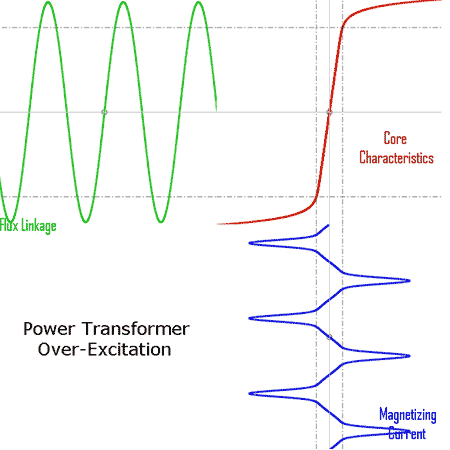
Magnetizing Current & Core Non-Linearity
Transformers themselves can generate harmonics due to core characteristics.
Core follows a non-linear B-H curve
Requires magnetizing current, which is non-sinusoidal
👉 Produces:
Predominantly odd harmonics (especially 3rd)
Even at no-load conditions
Core Saturation Effects
When a transformer operates near or beyond saturation:
Magnetizing current increases sharply
Waveform becomes highly distorted
👉 Leads to:
Increased harmonic content
Overheating and losses
4. Harmonic Propagation in Electrical Systems

Harmonics generated at one point do not remain localized.
They propagate through:
Transformers
Cables
Distribution panels
👉 Key Effects:
Neutral conductor overloading (due to 3rd harmonics)
Increased losses in cables and transformers
Possible resonance conditions
Conclusion
Harmonics are not limited to IT equipment—they are deeply embedded in industrial processes, lighting systems, and even transformers themselves.
As electrical engineers, understanding these sources helps in:
Identifying problem areas
Designing mitigation strategies
Ensuring reliable and efficient system operation
Which of these do you think is the biggest source of harmonics?
⚡ Arc Furnaces
💡 LED & Fluorescent Lighting
🔌 Power Electronics (UPS, VFDs)
🔁 Transformers

Comments